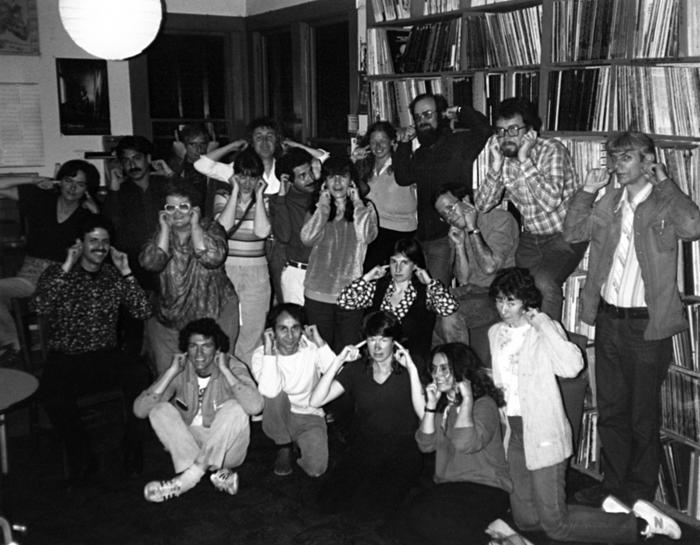
In 1974, the first and only Bay Area Synthesizer Ensemble (B.A.S.E.) was formed. This was an ensemble of electronic music studios at the University of California in Berkeley, radio station KPFA in Berkeley, the San Francisco Conservatory, and San Francisco State University. The studios were connected by special telephone lines which all led into the master control room at KPFA, where incoming signals were mixed electronically and then broadcast in real time. The performance broadcast took place on the evening of February 23, 1974. The compositions commissioned for the affair were “Responsive Reading” and “Thirty Seconds,” by Gareth Loy; “Music for B.A.S.E.,” by Anthony Gnazzo; “Quartet for Synthesizers,” by George Burt; “BASEment,” by Alden Jenks; “Recycled Radio,” by Jan Pusina; and “BASEball” and “A Ludwig Washout,” by Herbert Bielawa. Each studio had a production crew as follows: At San Francisco State were Gareth Loy, Rich McGinnis and Peter Donaldson; at the San Francisco Conservatory were Alden Jenks, Robert David and Neil Rolnick; in the back room at KPFA were George Burt, Barth Gehls, Valerie Farrell (Hielbron) and Herbert Bielawa; on the U. C. campus were Anthony Gnazzo, Barbara Jazwinski, Cardell Ho, Robert Coburn, Peter Lopez and Jan Pusina. There was yet another composer represented on the program, Mozart. The work was his “String Quartet in C Major.” A musician was stationed at each location where they each had a microphone and head set. At a fifth location (S.F. State ), in a different room was stationed a director of the ensemble, Laszlo Varga. Varga literally verbalized performance signals to the players. Beginning attacks, cut-offs, and general tempo processing were done verbally by Varga. Since there was no physical, visual, or audio contact now available to them, as there usually is in string quartet performance, Varga's signals were absolutely necessary and, in the end, gratefully sought by the players. Although the members of this virtual quartet could all hear Varga's instructions on their head sets, only their playing was mixed for broadcast. The arrangement was not a happy one for the players, because it was so foreign to them. In a genuine musical sense such an arrangement has little to recommend for it. But the idea was simply to see if it could be done using the technology of the day. In the end, with great patience and good will from the players, (plus understandable grumbling along the way), the performance came across with astonishing rhythmic accuracy, and noticeable expressive power. An innocent listener could be fooled. Note: Description taken from an article by Herbert Bielawa, the full version of which can be found at http://www.o-art.org/history/LongDur/Bielawa/B.A.S.E..html It is unclear if both Loy pieces are part of this recording, or if only Thirty Seconds is heard, which may be accidentally distorted or intentionally distorted. It is also unclear if the “Quartet for Synthesizer” is an alternative name for the arrangement of Mozart's String Quartet or a separate piece. |