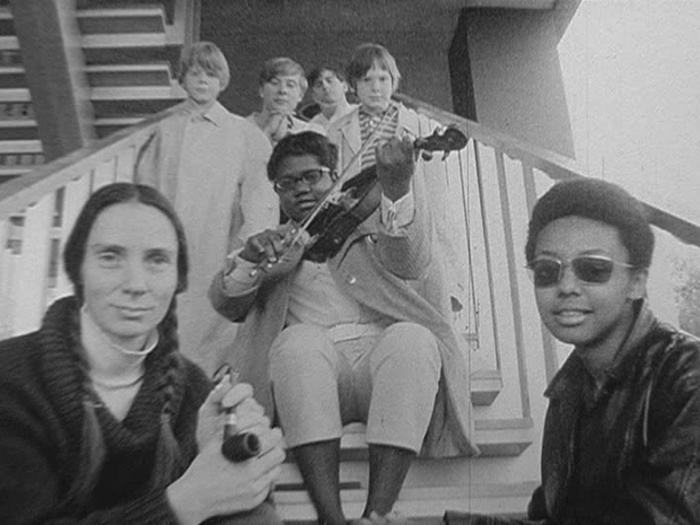
In September of 1970, the California Institute of the Arts opened its doors, thus embarking on a radical plan for art education, supported by the estate of the late Walt Disney. Several months prior to the start of its first academic year, Charles Amirkhanian and Richard Friedman visited the school, and talked with members of the extraordinary faculty who were to form the backbone of this remarkable intermedia educational institution. The program features an interview with Cal Arts provost, Herbert Blau, as well as discussions with various faculty members, and the Deans of each of the School’s major departments. Blau explains that the school was to be based on the modern reality of what art is, rather than more traditional academic formulations of what art was, or should be. Previous models for Cal Arts include the artistic apprenticeships during the Renaissance, the Bauhaus school, and Black Mountain College. Students were to be admitted based on their artistic talent rather than on SAT test scores or past academic transcripts. The school was to have no required curriculum, instead opting for a hands-on learning, and a philosophy of no knowledge in advance of need. Like Black Mountain College, the intention was to have the school be largely self-administered by the very artists that were to form its faculty, and even its students. A particular emphasis was to be placed on the intersection of all the various artistic disciplines represented at the school. In a series of interviews with such notable faculty members as Morton Subotnick, Alexander Mackendrick, Allan Kaprow, and Richard Farson, further light is cast on the vision of the school as one unencumbered by a rigorous and uniform curriculum. Instead, the intention was to create an institution that encourages innovation and experimentation, and individually tailored instruction. Given the School’s current list of accomplished alumni, it appears to have been a successful formula for arts education, and it is fascinating to hear how it all came about in 1970. |